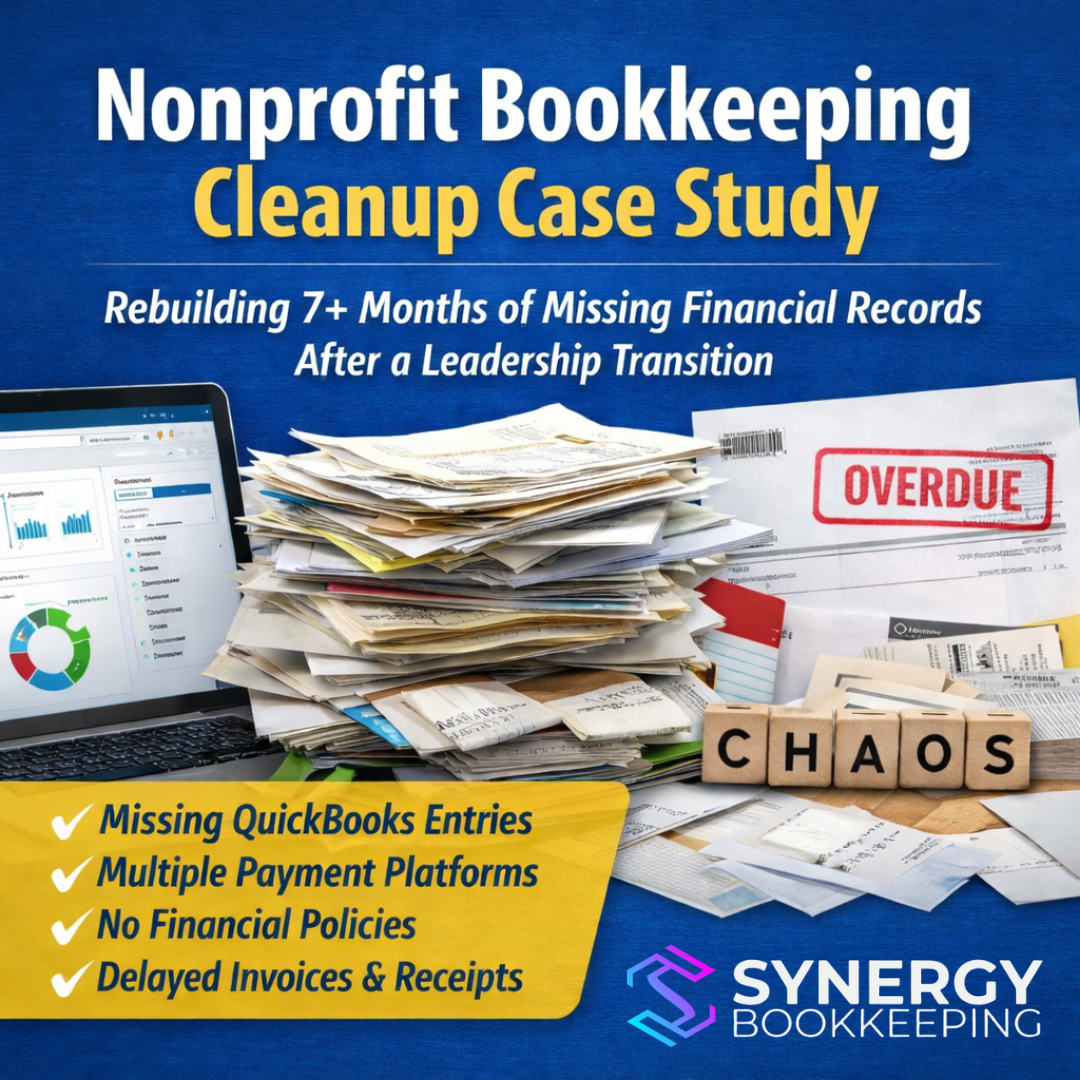
How We Rebuilt 7+ Months of Missing Nonprofit Bookkeeping
A Real QuickBooks Cleanup Case Study After a Leadership Transition
Volunteer-run nonprofits and service organizations accomplish remarkable work in their communities. But when financial responsibilities rotate among volunteers — especially in organizations where leadership changes annually — bookkeeping systems can sometimes fall behind.
Situations like this often require nonprofit bookkeepingcleanup, catch-up bookkeeping, and QuickBooks reconstruction work to restore accurate financial reporting.
Recently, Synergy Bookkeeping was asked to assist a volunteer-led 501(c)(4) nonprofit organization after a financial leadership transition created significant gaps in the organization’s accounting records.
What began as a routine review quickly turned into a major reconstruction project involving:
more than seven months of missing accounting entries
multiple payment systems collecting funds
scattered supporter and membership data
no formal financial policies
delayed invoices and receipts
and a board operating without reliable financial statements
This case study explains what happened, how the financial records were rebuilt, and the lessons other nonprofits and service organizations can learn from the experience.
What Happens When Nonprofit Bookkeeping Falls Behind?
Many nonprofit organizations rely on volunteer treasurers or financial officers who serve limited terms before passing responsibilities to someone new.
Over time, organizations often adopt new tools for collecting payments, managing events, or tracking supporters. Without consistent financial processes, these tools can create a situation where:
deposits continue to be made
expenses continue to be paid
but the accounting records are no longer being maintained properly
When this happens, leadership can lose visibility into the organization’s true financial position.
In this case, the organization’s board had effectively been operating for seven months or more without reliable financial statements.
A Common Situation in Volunteer Service Organizations
Many community-based nonprofits and service organizations operate with volunteer leadership that changes on a regular schedule — often every year.
These organizations typically have passionate volunteers managing responsibilities such as:
fundraising
membership or supporter programs
events and community outreach
marketing and communications
finances and bookkeeping
Because leadership rotates regularly, financial knowledge can sometimes become fragmented.
Each new treasurer or financial officer may inherit a system that was created by someone else — sometimes years earlier — without complete documentation or consistent procedures.
When this happens, small bookkeeping gaps can gradually grow into larger problems.
The Situation: Deposits Continued, But the QuickBooks Records Stopped
When we first reviewed the organization’s QuickBooks file, we discovered that bank deposits had continued to be made, but accounting entries had not been consistently recorded for several months.
The individual responsible for collecting mail and making deposits was still checking the organization’s PO Box and bringing checks to the bank. In many cases, a family member was helping deliver deposits.
However, the accounting records themselves had largely stopped being maintained.
There was an additional complication: the person responsible for handling mail and deposits was often difficult to reach.
It wasn’t until a direct phone call was made that we were finally able to obtain the QuickBooks file.
Fortunately, having access to the file meant we did not have to rebuild the books entirely from scratch — which would have made the situation significantly more complex.
But even with the existing file, several months of financial activity had to be reconstructed.
The Complication: Money Was Coming In From Multiple Systems
Another major challenge was the number of platforms the organization was using to collect funds.
Payments were arriving through several different channels, including:
online donation platforms
PayPal
fundraising and event tools
checks mailed to a PO Box
internal systems used to track supporter or ambassador participation
None of these systems were integrated directly with the accounting records.
As a result, deposits appeared in the bank account without clear documentation explaining:
what the payment represented
whether it was a donation or a renewal
which program it supported
which income category it belonged to
Identifying the purpose of each deposit often required researching several systems.
The Data Problem: Supporter and Ambassador Records Were Scattered
Another challenge involved identifying which individuals or organizations had renewed certain supporter or ambassador commitments during the previous year.
Records related to those renewals existed across multiple places:
payment platforms
internal membership systems
spreadsheets
email confirmations
bank deposit records
Because the data was fragmented across different systems, confirming who had renewed required reviewing multiple sources and cross-referencing information.
This type of fragmentation is extremely common in volunteer-led organizations that have gradually adopted new tools over time.
The Governance Gap: No Financial Policies
During the review process, another important issue became clear.
The organization did not have formal financial policies in place.
There were no documented procedures addressing key questions such as:
Who approves expenditures?
What documentation is required for reimbursements?
What is the deadline for submitting receipts?
When must vendor invoices be submitted?
Without clear policies, financial documentation often arrived long after the underlying expenses occurred.
For example:
One director submitted receipts for costume expenses related to an event more than a year after the event took place, and only for the receipts that could still be located.
Another director provided invoices from his company — which handles direct mail services for the organization — the night before a board meeting, even though financial statements had already been distributed earlier that week.
One of those invoices represented nearly $8,000 in expenses that had not yet been recorded in the books.
Situations like this make accurate financial reporting extremely difficult.
The Reconstruction Process
Restoring the organization’s financial records required a detailed reconstruction of several months of financial activity.
Over the course of nearly 100 hours, Synergy Bookkeeping worked through the following steps:
securing access to the QuickBooks file
reviewing historical bank statements
matching deposits to payment platforms
identifying and correcting duplicate entries
rebuilding missing accounting transactions
categorizing income streams properly
reconciling bank accounts month by month
updating financial reports for leadership
In many cases, deposits had been made correctly — but the corresponding accounting entries had simply never been recorded.
Until those transactions were rebuilt and reconciled, QuickBooks could not produce reliable financial statements.
This type of reconstruction work is common when organizations go through leadership transitions without a structured financial handoff.
The Result: Restored Financial Visibility
After completing the cleanup and reconstruction work, the organization’s books were fully reconciled through February 2026.
This restored accurate financial reporting for leadership and the board, allowing them to understand the organization’s financial position once again.
Equally important, the process revealed several areas where improved financial systems and policies could help prevent similar issues in the future.
The Hidden Cost of Waiting
One of the most important lessons from this project is how quickly bookkeeping gaps can become expensive to fix.
When financial records fall behind — particularly when multiple payment platforms are involved — reconstructing the activity requires significant time.
Bank statements, payment systems, deposit records, and historical data must all be reviewed and matched together.
Projects like this can easily require dozens of hours of reconstruction work, which can translate into thousands of dollars in professional cleanup services.
Consistent monthly bookkeeping is almost always far less expensive than rebuilding months of missing financial records later.
Lessons for Volunteer-Run Nonprofits and Service Organizations
This case highlights several lessons for nonprofit organizations.
Deposits are not bookkeeping
Depositing checks or receiving online payments does not create accurate financial statements.
Multiple systems require coordination
Organizations that accept money through several platforms must ensure those systems are properly tracked in the accounting records.
Financial policies matter
Clear policies for approvals, reimbursements, and documentation help maintain accurate financial records.
Leadership transitions require structured handoffs
Volunteer leadership changes frequently. Financial processes should remain consistent regardless of who holds the position.
Boards need reliable financial reporting
Accurate financial statements are essential for responsible governance and decision-making.
Signs Your Nonprofit May Need a Bookkeeping Cleanup
Your organization may need a bookkeeping review if:
financial statements haven’t been reviewed for several months
bank accounts are not reconciled regularly
deposits appear without clear documentation
multiple payment systems are used but not tracked centrally
receipts or invoices arrive long after expenses occur
leadership transitions have recently occurred
no one is sure who has access to the accounting file
Addressing these issues early is far easier than reconstructing months of missing records later.
Need Help Cleaning Up Your Nonprofit’s Books?
If your nonprofit or service organization is dealing with incomplete financial records — especially after a leadership transition — cleanup is possible.
At Synergy Bookkeeping, we help organizations:
clean up messy QuickBooks records
reconcile income from multiple platforms
restore accurate financial reporting
implement systems that support future leadership transitions
📅 Schedule a Free Consultation
If your nonprofit’s books have fallen behind — or if you're unsure whether your records are accurate — we can help you identify the issues and get your financial reporting back on track.