10 Signs Your MSP Has Outgrown DIY Bookkeeping
Most MSP owners do not start their business because they love bookkeeping.
They start because they understand technology, enjoy solving problems, see an opportunity to serve clients, or want to build something of their own.
In the early days, doing your own bookkeeping often makes perfect sense.
There may be only a handful of clients. A few vendor bills. One business credit card. Maybe no employees. QuickBooks is manageable, and paying someone else to handle the books can feel unnecessary.
Then the business grows.
You add managed service agreements. Employees. Microsoft 365 licensing. Security tools. Backup services. Hardware purchases. Projects. Payroll. More vendors. More credit cards. More transactions.
And somewhere along the way, the bookkeeping process that worked when the MSP was smaller stops working.
For many owners, the first warning sign is a familiar one: “we’ll clean up QuickBooks later” slowly becomes months of catching up.
The problem is that there is rarely a single moment when an owner announces:
“Today is the day I have officially outgrown DIY bookkeeping.”
Instead, the warning signs appear gradually.
After more than 30 years of running an IT services business, I know how easy it is for bookkeeping to get pushed behind client issues, projects, employee questions, sales opportunities, and the dozens of other things demanding an owner’s attention.
So how do you know when it may be time to get help?
Here are 10 signs your MSP may have outgrown DIY bookkeeping.
1. QuickBooks Is Always Behind
One of the clearest signs is also one of the easiest to normalize.
You tell yourself:
“I’ll catch up this weekend.”
Then the weekend gets busy.
A client has an issue Monday morning. A project runs long. An employee needs help. A proposal has to go out. Another month closes.
Before long, QuickBooks is:
A few weeks behind
Two months behind
Six months behind
Or only updated when tax time approaches
The danger is not simply that transactions have not been categorized.
When the books are behind, you are making decisions using incomplete financial information.
You may know what is in the bank account today, but not have a reliable picture of:
Current profitability
Outstanding obligations
Credit card balances
Loan balances
Expense trends
Cash flow
Whether margins are improving or deteriorating
One missed month can become several surprisingly quickly.
And the longer the books remain behind, the more difficult it becomes to remember what unfamiliar transactions were actually for.
2. You’re Doing Bookkeeping at Night or on Weekends
This is a major warning sign.
If bookkeeping routinely happens:
After dinner
Late at night
Saturday morning
Sunday afternoon
During a holiday weekend
the issue may not be whether you are capable of doing the work.
The issue is whether the owner of the business should still be doing it.
MSP owners often make this calculation incorrectly because DIY bookkeeping appears “free.”
But owner time is not free.
Suppose you spend five hours per month keeping up with QuickBooks.
If your time is worth $150 per hour, that represents:
$750 per month of owner time.
And that does not include the cost of context switching, procrastination, or the mental burden of knowing the books still need attention.
The question is not:
“Can I do my own bookkeeping?”
You probably can.
The better question is:
“Is this still the best use of my time?”
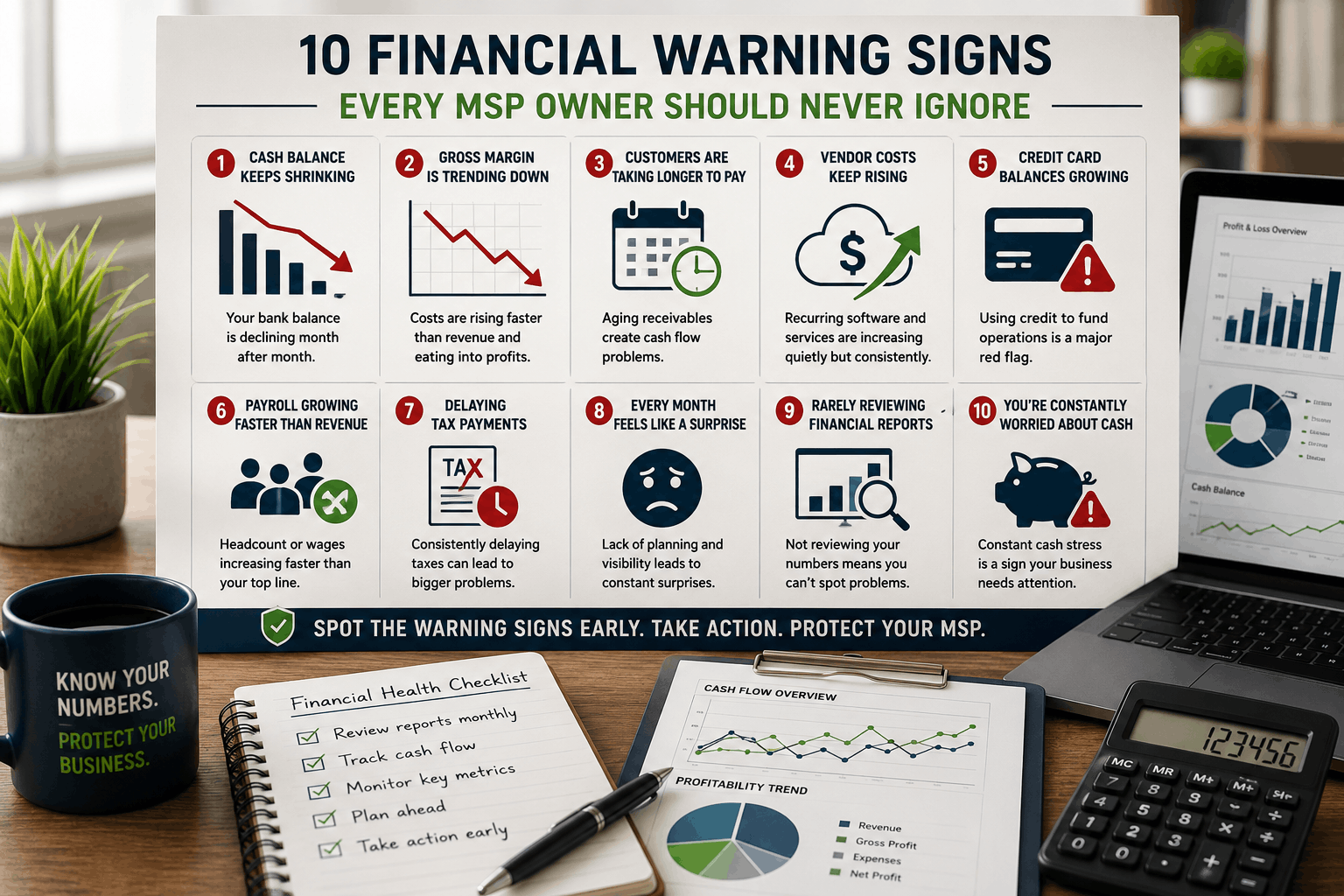
3. You’re Running the Business From the Bank Balance
This is one of the easiest habits for an MSP owner to fall into.
You log into online banking.
There is money in the account.
Payroll is covered.
The credit card payment can be made.
Everything feels fine.
But the bank balance does not tell you:
What clients still owe you
What vendor bills are coming due
How much is sitting on credit cards
Whether payroll costs are increasing faster than revenue
Whether recurring vendor expenses are eroding margins
Whether project work is actually profitable
Whether tax obligations are building
Whether the business is generating sustainable profit
A healthy bank balance can create a false sense of security.
A low bank balance can also create panic even when significant receivables are about to be collected.
Cash matters enormously.
We’ve written more about why so many MSP owners run their business off the bank balance—and why that number alone can create a misleading picture of financial health.
But cash in the bank is not a substitute for accurate financial reporting.
If you are making most financial decisions by checking the bank account, your MSP may have outgrown its current bookkeeping process.
4. You Can’t Confidently Explain Whether Your Managed Services Are Actually Profitable
Recurring revenue is one of the most attractive parts of the MSP business model.
But recurring revenue is not automatically profitable revenue.
An MSP may collect monthly fees while also paying for:
Microsoft licensing
RMM
PSA software
Endpoint security
Backup services
Email security
Documentation platforms
SOC or MDR services
Cloud infrastructure
Other per-user or per-device tools
As the stack grows, so does the cost of delivering service.
If revenue is recorded broadly while vendor costs are buried across multiple expense accounts, the owner may struggle to answer a basic question:
“Are we actually making money on the services we sell?”
This does not mean bookkeeping alone can calculate every operational metric in an MSP.
But the financial records should provide a reliable foundation for understanding revenue, expenses, gross margin, and trends.
If you cannot confidently explain where the money is going, that is a warning sign.
This is also why many owners struggle to understand their real MSP profit margins, even when revenue and recurring contracts appear strong.
5. Vendor and Licensing Costs Are Getting Harder to Track
A small IT company may begin with a relatively simple vendor stack.
Then the business grows.
You add:
More Microsoft subscriptions
More security products
More backup services
More cloud tools
More client-specific licensing
More distributors
More recurring platforms
Eventually, vendor activity becomes a significant part of the financial picture.
And this is where small errors can become expensive.
A recurring charge that increases gradually may go unnoticed.
A former client’s license may remain active.
A vendor charge may be categorized inconsistently from month to month.
Multiple tools may be lumped into a broad “Software” account that tells the owner very little.
Accurate bookkeeping will not replace vendor management or your PSA.
But if recurring vendor costs have become difficult to understand in the financial statements, your bookkeeping structure may no longer match the complexity of the business.
6. Your PSA and QuickBooks Tell Different Stories
Your PSA may tell you one thing.
QuickBooks may tell you another.
This is not unusual.
The systems serve different purposes.
Your PSA may track:
Agreements
Tickets
Projects
Time entries
Products
Client billing
Operational metrics
QuickBooks tracks the financial records of the business.
Problems arise when the owner assumes the two systems should automatically tell the same story without a disciplined process behind them.
You may discover:
Revenue totals that do not seem to match
Payments applied incorrectly
Old receivables that remain open
Duplicate activity
Project costs recorded inconsistently
Vendor expenses that are difficult to connect to service delivery
If you regularly find yourself wondering which system to trust, it may be time for a more consistent bookkeeping process.
7. Tax Time Becomes a Cleanup Project Every Year
Tax season should not begin with:
“We need to fix QuickBooks first.”
Yet for many businesses, that is exactly what happens.
The CPA asks questions.
Accounts have not been reconciled.
Transactions remain uncategorized.
Loan balances are wrong.
Old receivables are still sitting on reports.
Payroll does not look right.
The owner spends days searching for information from months earlier.
Then everyone rushes to get the books into usable condition.
If this happens every year, the problem is not tax season.
The problem is the monthly bookkeeping process.
Clean books throughout the year make year-end easier because problems are identified while the information is still fresh.
8. You Receive Financial Statements but Don’t Fully Trust Them
Maybe you run a Profit and Loss statement every month.
Maybe someone sends one to you.
But when you look at it, you wonder:
Is this accurate?
Why is that expense so high?
Why is that account negative?
Did we record payroll correctly?
Is that loan balance right?
Why does profit look good when cash feels tight?
A financial report is only useful if you trust the underlying books.
This is one of the most dangerous stages for a growing business because the owner technically has financial statements—but does not feel confident using them to make decisions.
The result?
They go back to the bank balance.
If you do not trust your P&L or Balance Sheet, your MSP may have outgrown the bookkeeping process producing those reports.
And even accurate reports provide limited value if they are not being reviewed and understood. We’ve also explored why so many MSP owners ignore their financial reports.
9. Revenue Is Growing, but Cash Still Feels Tight
This is one of the most frustrating experiences for an MSP owner.
Revenue goes up.
The client base grows.
MRR increases.
The team gets busier.
Yet somehow, cash still feels tight.
Why?
There are many possible reasons:
Payroll has increased
Vendor costs have grown
Accounts receivable is slowing down
Hardware purchases are consuming cash
Debt payments are increasing
Owner draws are too high
Pricing has not kept up with service delivery costs
Projects require cash before clients pay
Expenses are growing faster than revenue
Growth can hide financial problems because the business appears successful from the outside.
But more revenue does not automatically mean more cash.
That disconnect is one reason many MSP owners feel profitable but still struggle with cash flow.
If your MSP is growing and you still cannot clearly explain why cash feels tight, accurate monthly bookkeeping becomes increasingly important.
10. You Have Become the Bookkeeping Bottleneck
This may be the biggest sign of all.
The business cannot move forward financially until you:
Categorize transactions
Answer months-old questions
Find receipts
Reconcile accounts
Review QuickBooks
Update spreadsheets
Explain old charges
Finally sit down and catch everything up
In other words:
You have become the bottleneck.
MSP owners understand bottlenecks in technology.
If one person is the only person who can resolve a critical issue, the process does not scale.
The same is true in the back office.
A bookkeeping process that depends entirely on the owner finding enough time eventually becomes fragile.
And as the MSP grows, the problem usually gets worse—not better.
How Many of These Signs Sound Familiar?
One sign may not mean much.
Every business has a busy month.
Every owner falls behind occasionally.
But if you recognized your MSP in three, four, or five of these signs, it may be worth asking whether DIY bookkeeping is still serving the business.
The transition usually does not happen because the owner suddenly becomes incapable of bookkeeping.
It happens because the business has grown beyond the point where owner-managed bookkeeping is efficient.
That is an important distinction.
What Does Outsourced Bookkeeping Actually Change?
Outsourcing does not mean giving up financial control.
Done correctly, it should mean gaining better financial visibility.
A monthly bookkeeping process may include:
Transaction review and categorization
Bank reconciliations
Credit card reconciliations
Loan account reconciliation
Payroll bookkeeping
Review of unusual activity
Month-end adjustments
Profit and Loss statements
Balance Sheets
Communication about questions or discrepancies
The exact scope depends on the MSP.
But the goal is consistency.
Instead of asking:
“When will I find time to catch up?”
you have a repeatable monthly process designed to keep the books current.
If you’re still deciding whether outside help makes sense, we’ve also outlined how to know when it’s time to outsource your MSP’s bookkeeping.
What Does MSP Bookkeeping Cost?
That depends on:
Transaction volume
Number of financial accounts
Payroll complexity
A/R and A/P needs
Hardware activity
Project activity
Reporting expectations
The current condition of QuickBooks
For many small and growing MSPs, professional bookkeeping may fall somewhere around $300 to $1,500+ per month, depending on complexity and scope.
We recently published a complete guide explaining the factors that affect pricing:
How Much Should an MSP Spend on Bookkeeping?
That guide also explains what may be included in monthly service and why two bookkeeping proposals with very different prices may not be comparable.
Why Synergy Bookkeeping Understands MSP Owners
Synergy Bookkeeping is not approaching the MSP industry from the outside.
I have spent more than 30 years running an IT services business.
I understand what it is like when:
A client emergency destroys the schedule
A project takes longer than expected
Vendor costs keep increasing
Payroll arrives whether clients have paid or not
Hardware purchases consume cash
Recurring revenue looks healthy while the bank account tells a different story
Administrative work gets pushed to nights and weekends
I also understand how easy it is to tell yourself:
“I’ll deal with QuickBooks later.”
Later has a way of becoming months.
Synergy Bookkeeping provides specialized bookkeeping for MSPs, including QuickBooks cleanup and ongoing monthly bookkeeping.
Our goal is simple:
Clean, accurate books that give you a clearer picture of your business.
Has Your MSP Outgrown DIY Bookkeeping?
If several of these signs sound familiar, the question may no longer be whether you can keep doing the bookkeeping yourself.
It may be whether doing so is still the best use of your time.
Start with a free 15-minute QuickBooks Review.
We’ll talk about:
Where your books stand today
Whether cleanup may be needed
What ongoing monthly bookkeeping could look like
What the next step should be
No pressure. Just a straightforward conversation.
Schedule Your Free 15-Minute QuickBooks Review